Follow the Eyeballs: How Audience Measurement Tools Are Adapting to Digital Platforms
By Sébastien Turcotte, Senior Research Analyst, Audience Research
For decades, audience measurement has quietly shaped what Canadians watch. Ratings helped determine when shows aired, where advertising dollars flowed, and which projects received funding. But as viewing habits continue to fragment across platforms and devices, measurement strategies must expand to follow audiences where they are.
Today’s audiences drift between traditional television, broadcaster-owned streaming services (BVOD), global streamers, and social media feeds. Appointment viewing coexists with on-demand, binge-watching, and algorithm-driven recommendations. In this environment, no single measurement system can fully capture the lifecycle of a piece of content or the breadth of its cultural reach. Traditional ratings remain essential, but they increasingly tell only part of the story. In this environment, following the eyeballs has become far more complicated.
In Canada, Numeris continues to provide audience data on linear broadcasts and digital services, such as Crave, Gem, or Netflix. However, measurement on some of these digital platforms can be limited, sometimes capturing overall minutes viewed at the platform level rather than detailed, show-by-show performance. As a result, alternative sources such as Parrot Analytics offer a complementary lens, capturing demand signals generated across the digital landscape, including social media activity, web searches, streaming, and peer-to-peer downloads.
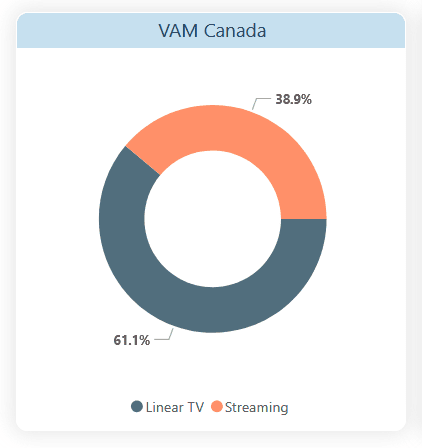
By incorporating different methodologies, stakeholders can gain a more nuanced understanding of content performance in a landscape where broadcast TV viewership constitutes only about 60 per cent of total consumption—a share that continues to shrink each year and drops even further among younger audiences.1
Through a series of case studies, this article explores how Numeris and Parrot Analytics capture distinct but complementary audience signals, and why integrating multiple perspectives is critical to understanding market performance in today’s landscape.
Measurement Platforms Scopes
Numeris ratings have long been the common language of broadcast television in Canada. Invented in the 1950s, they were designed for a simpler media world—one with only a handful of channels and a single screen in the living room. They offered a standardized way to estimate how many people tuned into a television program and allowed broadcasters, advertisers, and agencies to compare program performance consistently across markets and demographics. Numeris ratings remain a core benchmark for scheduling decisions, measuring advertising sales, and tracking the overall performance of Canadian TV programming.
To modernize and respond to industry needs, Numeris launched National VAM (Video Audience Measurement) in Fall 2025. National VAM complements traditional ratings by capturing how audiences engage with video content over digital platforms. It measures viewing on connected TVs, computers, tablets, and smartphones. National VAM provides insights into the share of digital video viewing per platform, plus some program-level information such as streams, minutes viewed, and audiences for participating BVOD platforms. By accounting for non-linear and on-demand viewing, National VAM addresses gaps left by traditional TV ratings and reflects how Canadian audiences increasingly access content beyond the broadcast schedule.
Parrot Analytics
Parrot Analytics gives insights into television series and films, both on broadcast and streaming platforms. Rather than being consumption-based like Numeris, Parrot measures what it calls “demand expression”—an indicator of how strongly audiences want to engage with a given piece of IP. This metric incorporates web searches, social media engagement, peer-to-peer downloads (piracy), and some publicly available streaming data.
The Canada Media Fund (CMF) uses Parrot data as a practical workaround for the limited data availability for streaming platforms. This is especially valuable for titles released exclusively online, as well as for shows that move to broadcast in a secondary window following an initial run on streaming, or vice versa. The CMF draws on both Numeris and Parrot Analytics to assess and report on audience performance. These tools provide a broader picture of how Canadian content is consumed across platforms. However, when it comes to the CMF’s Audience Success Factor—the metric that determines envelope allocations and how much funding each broadcaster receives—only Numeris data is used. As a result, viewing that occurs on streaming platforms does not contribute to Audience Success calculations. This creates a growing gap between how audiences watch content and what is formally captured by a single legacy measurement system—a gap that widens as viewing habits continues to shift.
The three case studies below show how Numeris and Parrot capture distinct but complementary audience signals, and why combining their data is useful to understanding market performance.
Case Studies: Measuring Success Across Platforms and Audiences
Heated Rivalry: Digital-First Discovery and International Demand
Heated Rivalry, 2025’s record-setting global hit, in which the CMF participated, is a remarkable case study in the evolution of audience ratings. This book-based hockey romance launched on Crave on November 28, 2025, and evolved from niche fandom to bona fide pop-cult phenomenon—in less than a month.
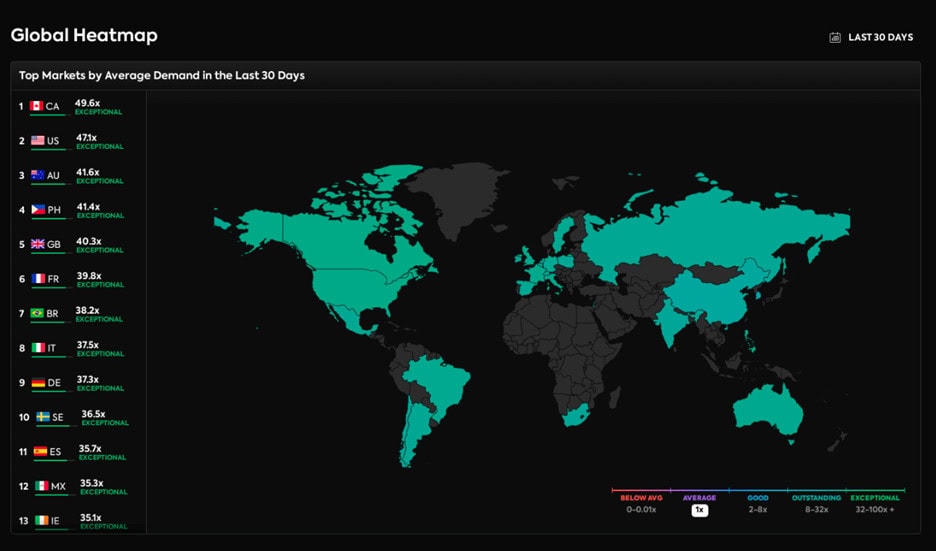
The CMF’s Audience Research team took a deep dive into how this happened. Bottom line, peak demand for Heated Rivalry clocked in at 95.72 times the average, placing it in the top 0.2 per cent of all TV shows worldwide. These insights are particularly useful when evaluating projects that serve specific audiences and/or demonstrate international traction. In the case of Heated Rivalry, the geographic distribution of audience demand points to sustained interest over multiple territories, underscoring the series’ ability to resonate beyond its domestic market. Alternative measurement tools like Parrot became essential to capture this sensation, because it was not measurable using traditional television ratings.
Empathie: Digital Success and Worldwide Recognition Leads to International Collaboration
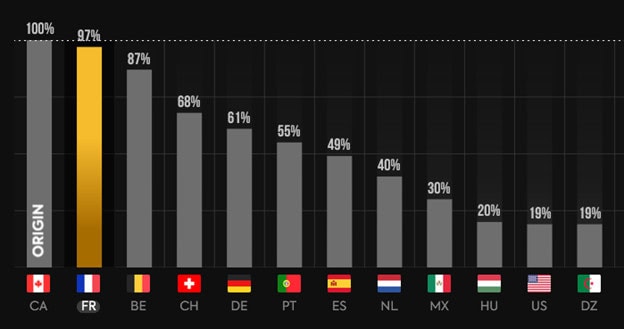
Empathie premiered in Canada on Crave on April 10, 2025, followed by a launch on France’s Canal+ four months later. Empathie is another example of success that would not have been captured without the use of additional metrics outside broadcast-based ratings. This French drama series from Quebec, created by and starring Florence Longpré, follows a criminologist turned psychiatrist. By tackling mental health with authenticity—and finding humanity and humour in difficult situations—Empathie connects with audiences well beyond its home market, giving the series broad international appeal.
The series had an earlier limited world premiere in March 2025 at the prestigious Séries Mania Festival in Lille, France, the largest television festival in Europe. Empathie made history as the first series produced entirely in Quebec to be selected for the competition, where it went on to win the Audience Award (Prix du Public). The show’s momentum continued internationally, earning additional awards in Italy and Spain. Parrot Analytics data showed that Empathie’s online demand closely mirrored its critical reception. Following its April 2025 launch, the series reached “outstanding” levels of daily demand in Canada, as well as in France and Belgium. The presence of French actor Thomas Ngijol as co-star likely contributed to the overseas success of Empathie. Sustained interest within France is further affirmed by Canal+ partnering with Crave to co-produce the second season slated for release in 2027.
North of North: Multiple Premieres, Growing Success
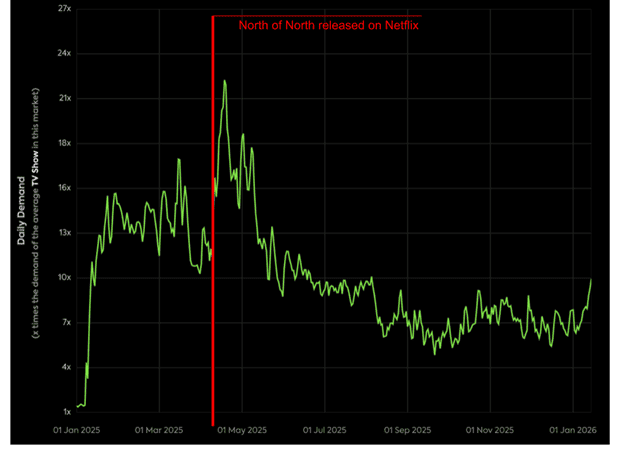
The case of North of North further illustrates how different release strategies generate distinct audience signatures. The series premiered on January 7, 2025, airing on both CBC and APTN, alongside a simultaneous launch on CBC Gem and APTN Lumi streaming platforms. Linear ratings showed an average audience of just over 200,000 viewers in Canada, a solid performance but not enough to place it among the top 10 CMF-funded programs for the period.
The more revealing story, however, emerged online. Parrot Analytics recorded a surge in demand expressions around the launch, reflecting strong engagement from streaming audiences. The momentum soared when North of North premiered on Netflix, on April 10, 2025, where it made the global top 10 for the first two weeks of its release. Its demand peaked at a daily 22 times the average demand for a show in Canada.
North of North was renewed for a second season and will begin filming shortly. In this case, the combination of linear ratings and demand-based metrics offered a more complete picture of the series—one that launched as a traditional broadcast event but ultimately flourished as a cultural property with broad digital resonance.
Conclusion: Multiple Lenses Matter
The case studies above make one thing clear: today’s audiences are not confined to a single screen, platform, or measurement system.
Numeris ratings remain essential for understanding broadcast performance, and National VAM adds an important piece of the puzzle by capturing how audiences engage with digital platforms. When taken with complementary tools, like Parrot Analytics, we see a more complete view of how Canadian content travels, resonates, and grows. Whether a series launches on broadcast television, debuts online, or finds a second life later through streaming, its true impact is best understood through multiple lenses. In a fragmented media landscape, relying on a single metric is no longer enough.
FOOTNOTES
- CMF Audience Research (Numeris); Linear TV & Streaming Platform Distribution, VAM Canada; September 1 to November 30, 2025.