The World Yearns for More Empathie
Empathie, a Crave original series supported by the Canada Media Fund, is an international sensation with a second season in the works. Lead actors Florence Longpré (also the screenwriter) and Thomas Ngijol expound on the show’s surprising success and the unique appeal of Quebec’s screen industry.
French actor and comedian Thomas Ngijol had no idea what was in store for him in the summer of 2024 when he agreed to star in Empathie. A Parisian of Cameroonian descent, he knew little about Quebec’s screen industry.
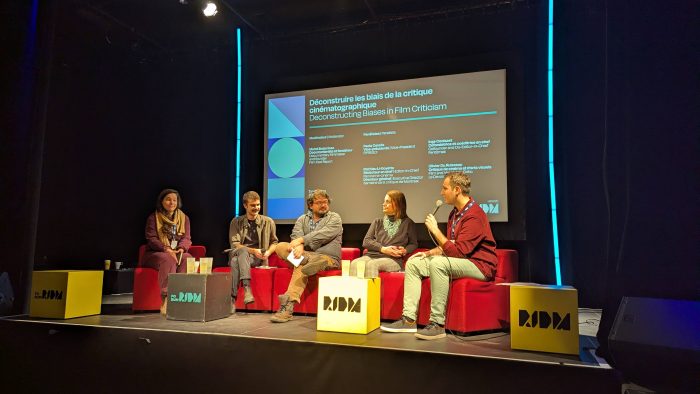
“If the series had been broadcast at 10:30 p.m., on an obscure channel, it wouldn’t have shocked or bothered me,” he said during the Nuit de la série panel organized by the Canada Media Fund (CMF) during the 31st Cinemania Francophone Film Festival. The event took place in Montreal this past November.

Nearly a year after the first episodes began streaming on Crave, Ngijol still can’t believe what’s happened. Empathie is the Canadian platform’s most-watched original French-language drama and its top performer in the country with all subscribers, across all genres and languages.
But Empathie’s success extends beyond our borders.
In March, Empathie earned an astounding 13-minute standing ovation and took home the Prix du Public, or Audience Award, at the Séries Mania Television Festival in Lille, France. More recently, the series was nominated at Europe’s Rose d’Or Awards and picked up prizes at the Serielizados Fest in Barcelona, Spain, and at the Venice TV Awards in Italy.
This past September, Canal+, France’s national television channel, started broadcasting Empathie in primetime. “The series is the fastest on record to reach 10 million views on the channel,” said François-Pier Pelinard Lambert, editorial director of Le film français magazine, during the Nuit de la Série panel.
Season 2 Already in the Works
In Season 1, produced by Trio Orange in collaboration with Bell Media, Suzanne (Longpré), a former criminologist, works as a psychiatrist at an institution for individuals convicted of crimes, who are not criminally responsible due to mental disorders. Suzanne and her intervention agent, the compassionate Mortimer (Ngijol), experience victories, small and large, each day, while Suzanne herself teeters on the brink after returning to work following a two-year absence.
Crave and Canal+ are currently collaborating on Season 2, scheduled for release in 2027, but Longpré wasn’t about to reveal any plot details. When asked about Season 2 during the Nuit de la Série panel, she joked, “Suzanne and Mortimer die.”
At the time, she’d only written the first five episodes.
“What I can tell you is that there will be some very exciting new storylines, and we will continue unfinished business from Season 1,” she said. “The idea is to remain true to our original approach while taking it a bit further.”
We’ll just have to wait.
So, how does Longpré cope with the pressure of success and the expectations it brings?
“At first, I pretended the pressure wasn’t there. Finally, I decided to accept it and embrace the rush that comes with it. But that doesn’t stop me from being stressed out or having a good cry, especially on a Monday morning when I’m menstruating,” she said with a wink.
Mental Health Is a Universal Theme
Based on his experiences with projects in North America, Europe and Africa, Ngijol thinks both seasons of Empathie will attract huge audiences in France and elsewhere in the French-speaking world.
“The concept of borders today is increasingly abstract, with global movement becoming more complex and frequent,” he shared in an exclusive interview, just after the Nuit de la Série panel. “We’re more and more connected, and when one culture encounters another we all come out the richer for it. We must continue working to make sure that fiction thrives here and everywhere. I think Empathie will even make it big in Africa.”
Ngijol believes the series has international appeal because it tackles mental health, a subject that is both universal and timely. “For years, anyone affected directly or indirectly [by mental health issues] felt ashamed and didn’t dare talk about it openly. People today are more open about mental health,” he said. “Empathie allows us to find the humour in it, to feel less alone, and to let it all out through laughter or tears, whatever works.”

Longpré, who, as a teen, went through a period of depression after her mother died, was eager to approach psychiatry with humour and compassion. Wanting to steer clear of stereotypes, she consulted with two psychiatrists. “Since it was a subject close to my heart I wanted to imbue the series with a generosity of spirit, or at least that’s what we were trying to evoke,” she said during the panel.
“As a writer, I delved into topics that I might not have explored initially and then did my best to explain them to viewers,” Longpré explained.
Ngijol thinks he knows why the message resonates so strongly with Quebec’s French cousins. “Our society is somewhat more cynical than yours. It’s more challenging for us to face difficult subjects and express how we feel.”
Originality Travels Well
Empathie stands out not only for the stories it tells, but also for director Guillaume Lonergan’s (Audrey est revenue, M’entends-tu?) use of bold visuals, surreal scenes and a striking soundtrack to heighten emotions. There are the ballerinas, dressed all in black, who metaphorically illustrate the balance and imbalance, strength and fragility, of coping with mental illness. And there are the rain clouds that often envelop Suzanne and reflect her deep inner sadness.
“[In Quebec] you allow yourselves the freedom to do things we don’t allow ourselves in France because we are too rational,” Ngijol said. “You might have fewer resources, but you compensate with greater creativity and freedom.”
For journalist Pelinard Lambert, this creativity is in demand from all over the world now that streaming has made it easy to access ideas and content from anywhere.
“We’ve known for many years that Quebec was rich in originality, but our interest was mainly in buying formats to adapt, as it happened with Un gars, une fille,” he said, referring to the Quebec series that was adapted by more than two-dozen countries. “Today it’s no longer the formats but the series themselves that are travelling abroad.”