Pass the Controller: Demographics and the Future of Gameplay
By Corinne Darche, Analyst, and Jon Montes, Research Lead, Strategy and Business Intelligence
Gaming is one of the most influential forms of entertainment in Canada. As of 2025, nearly 20 million Canadians play video games, joining an estimated 2.7 billion players worldwide.1 Far from a niche pastime, gaming now stands alongside film, television, and music in scale and cultural relevance.2 But the more meaningful shift isn’t how big gaming has become; it’s who’s playing and how they are playing.
Just as generational shifts have reshaped television consumption trends, gameplay habits vary significantly across different generations. The average gamer worldwide is now 41 years old, right in line with the age of the average Canadian.3 Today, being a “digital native” is no longer limited to kids or teens. Millennials and Gen Z have carried gaming into adulthood, and Gen Alpha will soon join them. The differences in their gameplay will define the industry’s future.4
A Generational Lens on a Growing and Diverse Market
Canadians are continuing to adopt gaming into their media diets, spending over eight hours a week playing.5, 6 And that number will likely rise. Between 2024 and 2030, the number of Canadian gamers is set to increase by 15 per cent. In comparison, the national population is set to grow by 2.7 per cent over the same time frame.7, 8 The data is clear: Canadians are getting more technologically connected, and that connection translates to gaming. To understand what that growth will mean for the sector, examining how younger demographics—the ones set to grow as generations shift—engage with games is crucial.
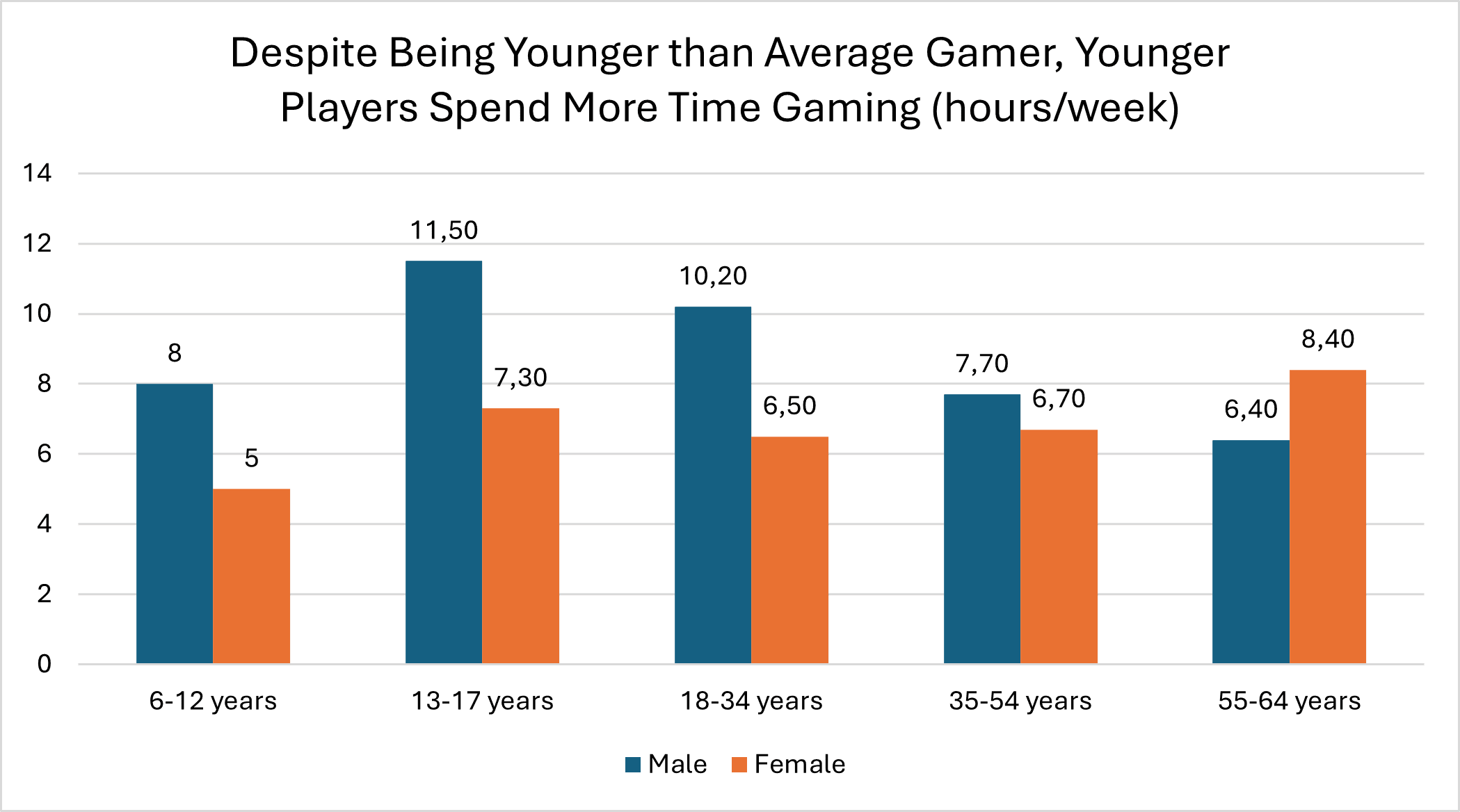
Perhaps unsurprisingly, players aged 13–17 spend the most time gaming, with male gamers averaging 11.5 hours and female gamers 7.3 hours per week.9 Gameplay averages then decrease among older generations before slightly ticking up again between 55–64.10
At first glance, this appears to contradict the fact that the average Canadian gamer is in their early forties. The full explanation lies in demographics. Players aged 35–54 make up 37 per cent of Canadian gamers, outnumbering their younger counterparts, despite playing fewer hours per week on average.11 In other words, Millennials and Gen X dominate by volume, while younger players in Gen Z and Gen Alpha dominate by intensity. Uniting the two age groups is family connection, as data reveals that Millennials use games to bond with their Gen Alpha kids.12, Parents view gaming as a meaningful investment not just for the kids, but for the family unit. This is even more apparent when looking at holiday shopping data. During the 2025 holiday season, parents who bought gaming gifts for their kids planned on spending over $750 for those gifts.13 Co-gaming may prove to have enormous impact on the sector at large as those younger players grow up.
Younger Gamers Focus on Social Connection
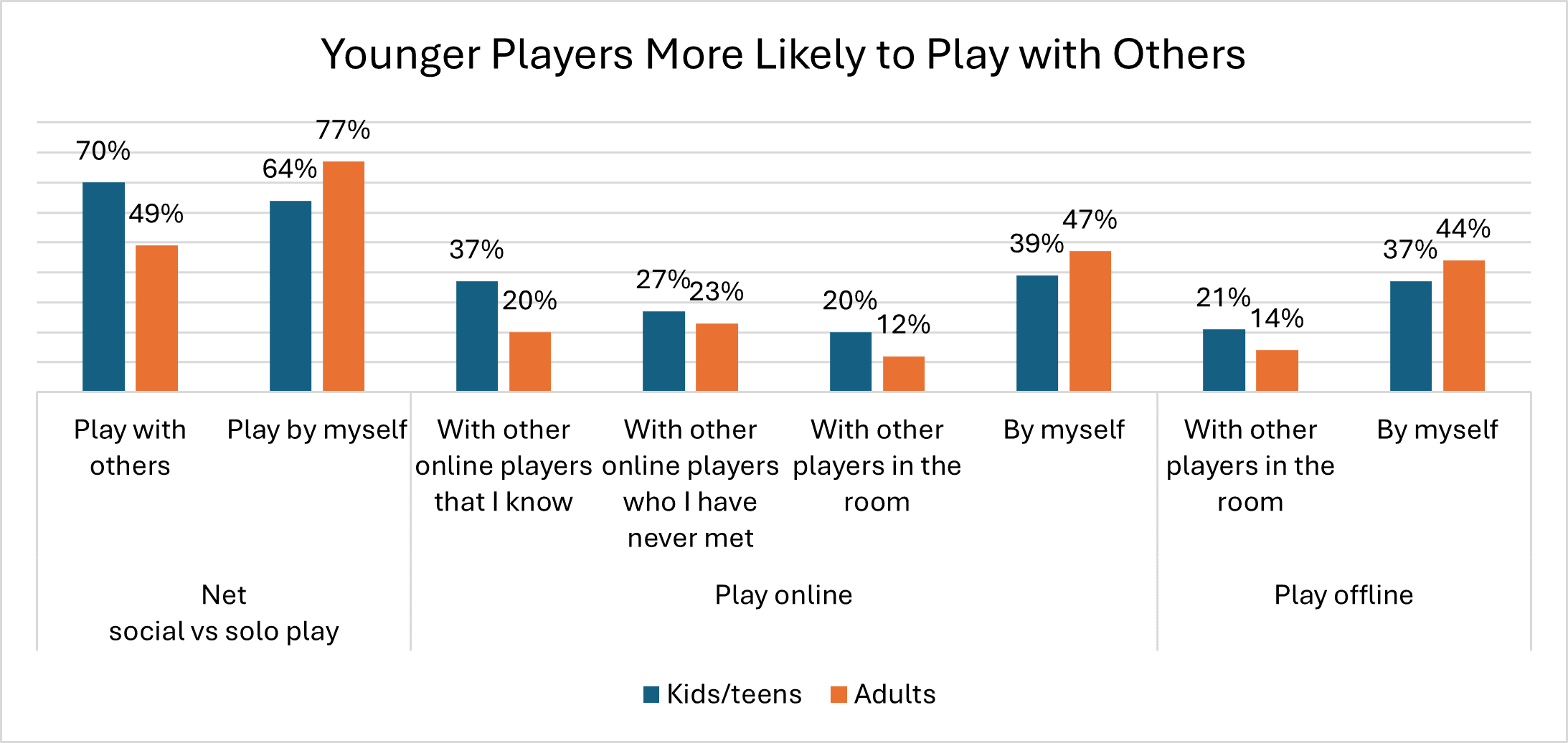
As younger gamers start growing in numbers, social gameplay is poised to redefine gaming. Kids reported high rates of solo play but, unlike older gamers, a clear majority—70 per cent—spend their gametime playing with others, either in-person or online. And that social connection is paying off: 73 per cent of gamers under 35 reported having good experiences meeting people through video games who they otherwise would not have met, compared to 41 per cent of gamers over 55. Thesepatterns suggest that games designed for shared connection will be better suited to meet the needs of younger gamers as they age.
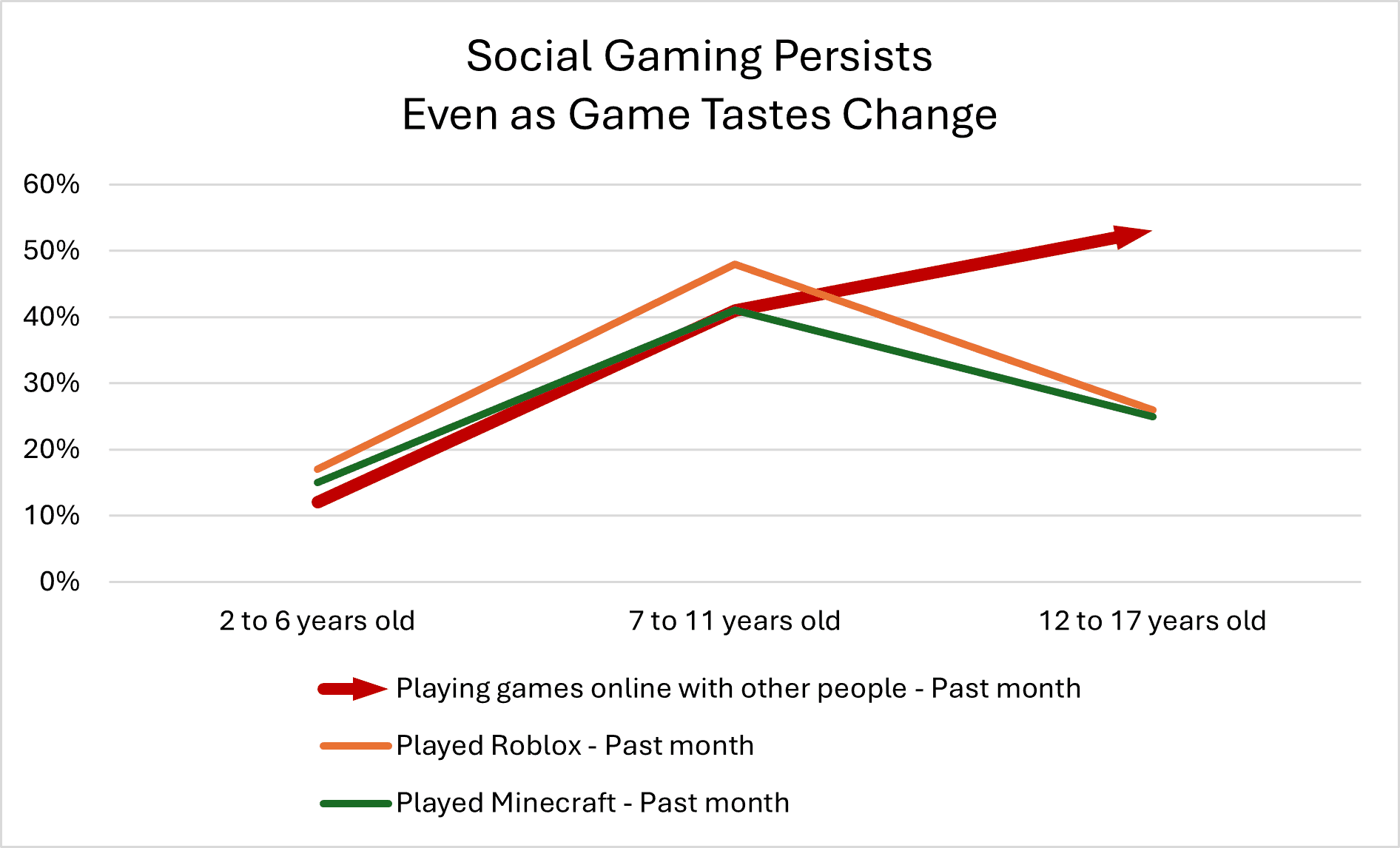
Another dive into Gen Alpha confirms this behavior and offers additional clues to where their gaming preferences lie. Social, collaborative platforms like Roblox and Minecraftprioritize shared play over high-end graphics, peaking among 7-to-11-year-old players. At the same time, the number of young gamers who play online with others steadily increases.14 For younger gamers then, the appeal lies less in the individual game and more in playing where their friends already are. Younger gamers are also more likely to trade 8K graphics and powerful PCs in favour of digital hangout spots, like browser-based games.15 This signals a shift away from the high-production value hallmarks of the AAA gaming world to a landscape that values interpersonal connection over flashiness.
To a degree, this shift is already being felt as younger gamers take up programming thanks to video games. While Myspace and Tumblr introduced Millennials to web development, social gaming platforms themselves are giving Gen Z and Gen Alpha an entry point into game design and back-end coding. In Roblox’s case, the platform invites players to create their own experiences through its built-in developer tools, which are often a first stop for younger coders. In a recent survey of US Roblox developers, 74 per cent had a high school education or less, and 33 per cent didn’t even have formal training in programming.16 This impact will be felt long after these players age out of the platform as they may continue to seek games that let them tap into their creativity and coding literacy—or simply create their own.
Future-Proofing Content, Not Just Gameplay
With the sheer volume of games being released every year—over 20,000 were released on Steam in 2025—developers are exploring ways for their games to break through the noise.17 One of those new frontiers may be to tap into underserved corners of the community, including exploring genres that over-index with specific groups. For example, many Asia-Pacific (APAC) game studios have specialized in otome games, or story-based romances, which are popular with 16-to-24-year-old female gamers.18 Meeting underserved markets coupled with an understanding of players’ habits is a core strategy for growth in this saturated sector.
This strategy could also mean exploring more inclusive game mechanics to unlock new audiences. In the United States and the United Kingdom, nearly a third of gamers identify as being disabled, compared to approximately 16 per cent of the general population. Despite these figures, developers have struggled to provide accessible features and game mechanics.19 For developers who prioritize accessibility, it could lead to innovative game design.
One trailblazing example is The Vale: Shadow of the Crown by Niagara’s Falling Squirrel. Facing budget constraints, the game’s developers embraced stripped-down visuals, which helped tap into an important and underserved market. Extensively consulting with the Canadian National Institute to the Blind (CNIB), the game’s designers leaned into non-visual cues that opened gaming possibilities for players with low vision or blindness. Players must use their other senses, whether listening for audio cues or interpreting haptic feedback from their controllers, to navigate the world and progress.
The Vale’s unique format was applauded by long-standing gamers for its originality and by visually impaired players for its accessibility, earning it industry prizes from Ubisoft and Reboot Develop.20 Although its total units sold might not rival blockbusters, user reviews are 98 per cent positive,21 an outstanding feat in a crowded market. Following this success, Falling Squirrel has partnered with CBC Kids to develop more blind-accessible games, including Echo Hunter, which won Best Game from the Youth Media Alliance Awards. Clearly, tapping into inclusive opportunities could be a market strength.
Looking Ahead: Changes for the Industry and the Ecosystem
Gaming is no longer just the domain of kids and teens—the faces of gamers span generations. Yet it is the social, collaborative, and creative habits of younger players that are shaping the future of play. As Millennials, Gen Z, and Gen Alpha take the lead in shaping consumer habits, the details of what, how much, and how in their gaming preferences will become increasingly distinct. To make the most of this opportunity, studios can leverage this shift by leaning into social online gaming and inclusive design that resonate on a global scale. Overall, how the industry responds to these evolving behaviours will determine the games, experiences, and communities that define Canadian gaming for years to come.
FOOTNOTES
- “Video gaming worldwide – Statistics & Facts.” Statista, accessed on January 22, 2026, https://www.statista.com/topics/1680/gaming/?srsltid=AfmBOooS2bAPbxI6F2GU4D5VIID2qxDuqJw1xuIR3l-nZNOn9NQ13lwU.
- Gu, Tianyi. “Year in Review: 2025 to date.” Newzoo, December 18, 2025, https://newzoo.com/resources/blog/year-in-review-2025-to-date.
- “Power of Play: 2025 Global Video Games Report.” Entertainment Software Association, October 2025, p. 7, https://www.theesa.com/resources/the-global-power-of-play-report/.
- Exact generational divides vary, especially for younger generations. Generational definitions used in this article for Millennials and Generation Z define Millennials as those born between 1981 and 1996 (currently 30-45) and Gen Z as those born between 1997 and 2012 (currently 14-29). The definition of Generation Alpha follows the definition proposed by Statistics Canada as those born between 2010 and 2024 (currently 2-16).
- Please note that the Entertainment Software Association of Canada reports 7.9 hours per week whereas Media Technology Monitor reports 8.4 hours per week.
- “Bringing Canadians Together through Gaming: Essential Facts 2022.” Entertainment Software Association of Canada, November 9, 2022, p. 5, https://theesa.ca/wp-content/uploads/2022/11/EF2022_EN.pdf; “It’s in the Game: Gaming in Canada.” Media Technology Monitor, January 26, 2023, p. 4.
- “Table 17-10-0058-01: Components of projected population growth, by projection scenario (x 1,000).” Statistics Canada, https://www150.statcan.gc.ca/t1/tbl1/en/tv.action?pid=1710005801.
- Statistics Canada’s population projections based on a medium growth (M1) scenario. Immigration continues to be the largest driver of population growth – especially for Generation X, Millennials, and Generation Z. While federal government targets for immigration have decreased recently, those targets are still in line with the medium growth scenario.
- “Bringing Canadians Together through Gaming: Essential Facts 2022.” Entertainment Software Association of Canada, November 9, 2022, p. 5, https://theesa.ca/wp-content/uploads/2022/11/EF2022_EN.pdf.
- “Bringing Canadians Together through Gaming: Essential Facts 2022.” Entertainment Software Association of Canada, November 9, 2022, p. 6, https://theesa.ca/wp-content/uploads/2022/11/EF2022_EN.pdf.
- “Power of Play: 2025 Global Video Games Report.” Entertainment Software Association, October 2025, p. 21, https://www.theesa.com/resources/the-global-power-of-play-report/.
- “Bringing Canadians Together through Gaming: Essential Facts 2022.” Entertainment Software Association of Canada, November 9, 2022, p. 4, https://theesa.ca/wp-content/uploads/2022/11/EF2022_EN.pdf.
- “Leveling up the Holidays: Over Half of Canadian Kids Asking for Video Games This Season.” Entertainment Software Association of Canada. December 8, 2025. https://theesa.ca/leveling-up-the-holidays-over-half-of-canadian-kids-asking-for-video-games-this-season/.
- Media Technology Monitor. MTM Junior, 2024 National survey.
- Wilde, Tyler. “‘There is a chance that they will stay in Roblox’: Gen Alpha is into PC gaming, but one industry analyst isn’t so sure they’re going to age out of their favorite haunt.” PC Gamer, September 19, 2025, https://www.pcgamer.com/games/gen-alpha-roblox-newzoo-analysis/.
- “Roblox US Economic Impact Assessment 2025.” Nordicity, September 29, 2025. https://corp.roblox.com/pdf/2024-us-economic-report-en.
- “Steam Game Releases by Year.” SteamDB, accessed on January 20, 2026, https://steamdb.info/stats/releases/.
- “Webinar: Gamers in 2025 – Audience trends and opportunities.” Ampere Analysis, September 4, 2025.
- Venables, Rachel. “Why gaming is not just a hobby but a lifeline for millions of gamers.” Sky News, September 2, 2025, https://news.sky.com/story/why-gaming-is-not-just-a-hobby-but-a-lifeline-for-millions-of-gamers-12952807.
- “Niagara indie game studio releases audio-based action-adventure game, The Vale: Shadow of the Crown.” Innovate Niagara, August 19, 2021, https://www.innovateniagara.com/site/blog/2021/08/19/niagara-indie-game-studio-release-the-vale.
- “Customer reviews for The Vale: Shadow of the Crown.” Steam, https://store.steampowered.com/app/989790/The_Vale_Shadow_of_the_Crown/#app_reviews_hash.