Spinning Ben Johnson’s story into comedic gold
We catch up with the creative team behind the six-part series Hate the Player: The Ben Johnson Story, which takes a comedic look at the life and legacy of Canadian sprinter Ben Johnson. Find out why the story of Johnson’s fall from grace is told from his point of view, and why the team leaned into the laughs to tell this story.

Hate the Player. It’s a bio-pic. It’s a sports show. It’s an outrageous comedy. It’s a love letter to Jamaican Canadians. It’s a series that takes big swings and hits it out of the park.
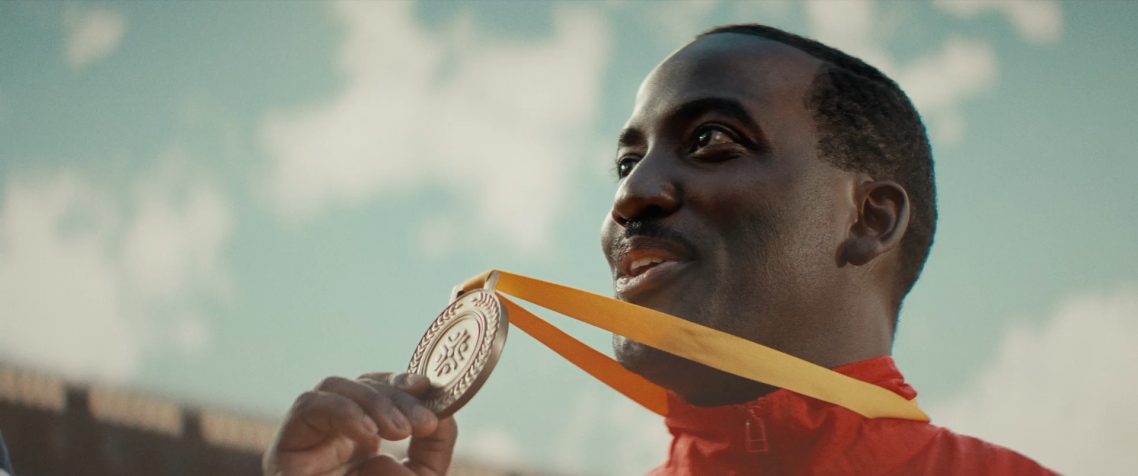
The six-part production (currently streaming on Paramount+ Canada and GameTV) chronicles the life and career of Canada’s most revered, and then reviled, sprinter Ben Johnson, who won gold in the 100 metres at the 1988 Summer Olympics only to have it stripped away when he tested positive for steroids.
“[The show] is about putting some shine back on Ben's name,” says Hate the Player’s creator and showrunner Anthony Q. Farrell, “and talking about how we put him on this pedestal and then we knocked him off it. And then we started to beat the crap out of him with it. It’s about telling his story from his point of view.”
Farrell is speaking at the Black Screen Office (BSO) Symposium in Toronto, where Hate the Player’s creative team recently gathered to chronicle how the show came together and why it stands out in the media landscape. Farrell was joined by the now 64-year-old Ben Johnson, Hate the Player’s stars Shamier Anderson, who gives a stellar turn as Johnson, Karen Robinson who plays Johnson’s mother, Gloria, and executive producer and New Metric Media CEO Mark Montefiore.
Montefiore reveals it’s taken six years for Hate the Player to reach screens, and that it was originally conceived as a drama. However, telling the story as a drama wasn’t working, which is why he sought out comedy writer/director Farrell (The Office, Shelved).
Finding the Comedy
“We really wanted it to be funny,” Farrell explains. “Find the comedy, find the jokes. It's a Canadian story, it's a Black story, and one of the things that those two cultures know how to do is find comedy in things.”
The humour veers from subtle jabs at sports media and racist track officials to slapstick to all-out ridicule. Johnson’s archrival, American sprinter Carl Lewis, is skewered unmercifully, which posed a problem for the show as it could be construed as libelous. That’s where the character of Walter the lawyer, played by Mark McKinney, entered the picture.
“We were dealing with the legal team who didn't want us getting sued while we were making the show,” says Farrell. “One of the things they said was you need a counterpoint; someone who is telling the other side to the story that's not just Ben’s. So, we came up with this idea: What if I just take the stuff the lawyers are sending me and just put it in the show? What was funny is the lawyers, once they got the hang of Walter, they started writing for him. I was like, is that a legal note, or are you pitching? They said, ‘We're pitching,’ and I was like, ‘No, you do the legal thing. I'll decide what goes in,’” he says with a chuckle.
Becoming Ben Johnson
The weight of the show rests on the brawny shoulders of Anderson, who had only six weeks to get into shape to resemble the extraordinarily fit Johnson. Another challenge was portraying Johnson throughout his entire life, from childhood to a man in his 60s.
“I think it’s important to mention I chose not to meet Ben until 48 hours before going to camera,” reveals Anderson. “The reason for that is because Ben's a very different person now than he was back in his 20s, his 30s, his 40s. Thankfully, with YouTube and Google, there's a lot of resources out there for me to pull from. And then when I sat down with him it was less about me being a journalist interviewing him, but just connecting with his heart and seeing the human today.”
Johnson, a self-effacing and soft-spoken panelist, chimes in on their meeting.
“[Shamier] invited me to his house to have a meal and get to know each other. I know his Jamaican background, and we were looking at each other and we smiled. We smiled at each other because we have a connection. He played me perfectly — the way I speak sometimes, the way I move, and what I say. And like he said, it was short notice for him to get back in shape very quickly.”
A New Perspective
For veteran actor Karen Robinsion, Hate the Player was a unique comedic project that also allowed her to reflect on her past as a young Jamaican woman who moved to Canada as a teenager.
“Reading the script, my first reaction was this is absolutely bonkers,” she says, smiling. “It was just so completely unexpected and off the wall and ballsy. I thought they're really taking a chance with this one and I really need to be a part of it. In terms of why I thought it was an important story to tell, is because [when Johnson was stripped of the medal] I'd only been in this country for four years and I was in Calgary, and I remember white people coming up to me and saying, ‘So, how do you feel about what happened?’
“As a 20-year-old, my critical thinking skills weren’t developed enough to address that question in the way that I would now, and I realize I never asked myself what Ben's side of the story was. It was only about what I was reading and what I was hearing and how people were approaching me as the only Jamaican they knew and asking me how I felt about it. So, I feel like being asked to join the project I’ve been given an opportunity to explore that side of the story.”
Despite a tight budget and production window that meant Farrell had to make some cuts to the script, Hate the Player found its narrative tone and stayed true to it. It was a challenge but, as he tells us, the key to getting things made lies in being open to what comes your way.
“I think a lot of times as artists, we get to a place where it has to be this, it has to be that, it has to be this. No, be open. If you understand what the core of your vision is and you know what story you're trying to tell, there are a lot of different ways to tell it. Be open to the way the universe is aligning.”