Immersive storytelling: How two Indigenous creators are exploring the XR landscape
Visitors to TIFF: The Market’s inaugural Innovation Hub can experience how extended reality (XR) is helping artists Laakkuluk Williamson Bathory and James Monkman share Indigenous culture in a way that goes beyond traditional film and art.
Multidisciplinary artist Laakkuluk Williamson Bathory thinks back to 2018, the first time she saw a virtual reality (VR) film. Biidaaban: First Light, from Indigenous filmmaker Lisa Jackson, depicted a downtown Toronto reclaimed by nature. “It really blew me away how she immersed you into the poetry of the world,” she says.
Williamson Bathory, who has Greenlandic, Canadian and Inuit roots, already had an extensive background in theatre, poetry and short art films when she decided to wade into VR, one component of extended reality (XR), which also includes augmented reality (AR) and mixed reality (MR).
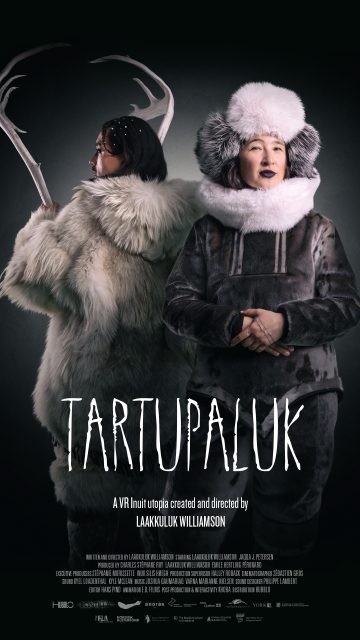
A political satire performance piece she’d written based on her own fictional story, We Are a Nation of Lovers, inspired the plot, which centres on the flamboyant woman president of a fictionalized version of Tartupaluk, the real 1.2-square-kilometre island that lies between Greenland and Nunavut and is also known as Hans Island after the Greenlandic Inuk explorer Hans Hendrik. In Williamson Bathory’s tale, the president invites lovers from various nations that have laid claim to Tartupaluk to join together and create a utopian republic.
"My co-producers and I cooked up the idea of making it into a VR film,” explains Williamson Bathory. “So, it is really a cross-section of theatre and film and an immersive environment.”
The production began as an eight-minute prototype titled Tartupaluk which, in 2023, exhibited at the Venice Film Festival, Arctic Arts Summit, imagineNATIVE Film + Media Arts Festival and Berlinale. “It got a lot of foot traffic at the Berlinale,” Williamson Bathory recalls. “They’d never had so many people come to the exhibition space ever, so we knew we were on to something.”
From there, Williamson Bathory and her team of co-creators went to work. Montreal-based film and XR studio Scintilla, Greenlandic-Danish production company Ánorâk Film, Montreal animation studio E.D.FILMS, and Khora, a VR and AR studio in Copenhagen, combined their talents to create the 360-degree environment of Tartupaluk. The eight-minute prototype became the first of six chapters in the 31-minute piece, which audience members experience by wearing a VR headset with headphones.
Learning to think a different way
Williamson Bathory admits there was a learning curve to grasping a new, technology-forward medium. “When we first started having meetings, I felt like I had to open up my cranium when they were asking me creative questions,” she says. “But I got the hang of it.”
The bulk of live-action filming took place in the summer of 2025 in Iqaluit, where Williamson Bathory is based. Filming in Northern Canada came with challenges — less infrastructure and higher costs, to name a few — but it was a must for Williamson Bathory. “The city and the land and the community give us such a creative edge that what we create here isn’t possible anywhere else,” she explains.
One potential hurdle came with their plan to film on an island accessible only by an hour-long boat ride from Iqaluit. “The sea ice stayed in place until the day before we were due to go filming,” Williamson Bathory recounts. “My co-producers said we needed to have a Plan B and C but, sure enough, the ice broke and we were the first boat to get out onto the water. We had an absolutely gorgeous day filming on the island.”
After live-action filming was complete, the production team went to work layering animation, music and other technologies onto the film to create an immersive, interactive experience. In one chapter, the Northern Lights surround the island. “You’re given the choice of making the Northern Lights come closer to the ground or getting them to lift up back into the sky,” says Williamson Bathory. They also transformed footage of Iqaluit-based actors into figures animated within the Northern Lights.
Ceremony as art
Immersive artist James Monkman is also discovering how such immersive art can be used to share his Cree roots. While his background is in art direction, in film, TV, animation and visual FX, Monkman discovered immersive art when working with key collaborator Brian T. Moore on Indigenous architect Douglas Cardinal’s installation UNCEDED: Voices of the Land for the 2018 Venice Biennale. “I really got excited about how we could share Indigenous stories and ways of knowing in an immersive context,” Monkman says.
During the pandemic, Monkman worked as the artistic director on filmmaker Ahnahktsipiitaa’s VR piece This is Not a Ceremony. Monkman and his partner in both work and life, Renée Kwan Monkman, who studied Cree cosmology, theology and philosophy, were inspired. James and Brian T. Moore thought about how they could create an immersive environment, but one that could be experienced in a communal way.
Making interactive installations mobile and modular
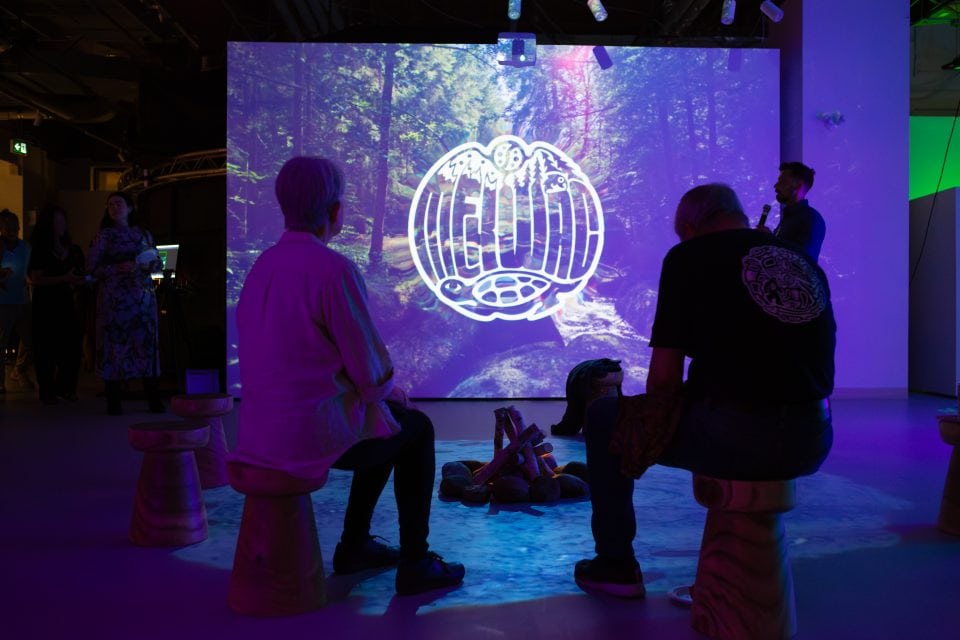
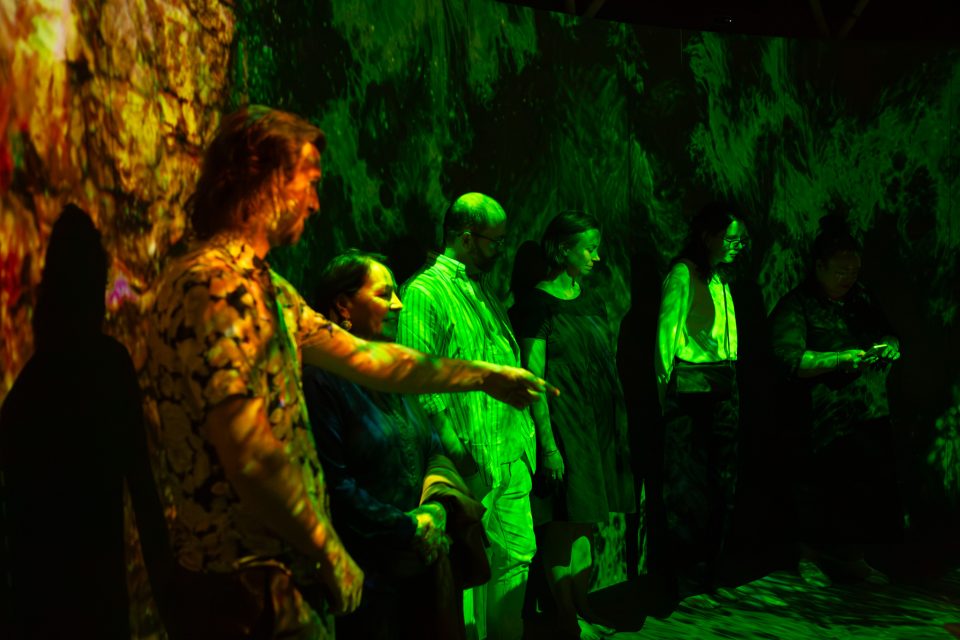
Mekwâc: “Now Is Good” is an installation created and directed by Monkman in collaboration with Renée Monkman, Brian T. Moore and Nigel Irwin, inspired by traditional Indigenous ceremony and deliberately designed to be mobile and modular. “We started thinking about form and Indigenous ways of knowing and how the circle is so important,” Monkman explains. That resulted in the creation of a 24-foot-wide circular theatre for a 360-degree experience that could be set up almost anywhere. “All we really need is a plug, a 30-foot-by-30-foot room and 12-foot ceilings,” he explains.
The installation takes visitors through four stages of life: they begin in the womb, are born into an underwater world teeming with sea creatures, move to adolescence in a forest with bears, wolves and eagles, adulthood is a prairie with buffalo, then they drop back into the earth in a web of mycelium and enter the spirit world to return to the womb. The whole cycle lasts 23 minutes, but it’s designed to be looped so audience members can enter and exit at any point.
Mekwâc’s interactivity is important. Alongside 13 projectors (13 is significant in Cree culture), there are four LiDAR (light detecting and ranging) sensors that respond to participants. For example, stepping on various rocks in the forest world makes different animals appear. And in the spirit world, mycelial fibres react and move toward participants. “You get to experience the piece more when you’re with someone else,” notes Kwan Monkman. “You see how they’re acting and how the space reacts to them.”
The installation debuted in the summer of 2025 at Collision Gallery in Toronto’s Financial District.
Growing awareness of XR art
Monkman says it was a challenge, at first, to explain his immersive projects. “When you start saying it’s an Indigenous experience that uses multi-projection, people can kind of glaze over until you show them something,” he says. But awareness is growing. This year, both Mekwâc and Tartupaluk will be part of TIFF: The Market’s inaugural Innovation Hub, which is being presented in partnership with the Canada Media Fund.
Monkman says more distinct funding and distribution pathways for immersive art can help the medium succeed. “Most of the funding strategies are still geared towards film and TV,” he says. “So anything that’s deemed immersive is put in this giant pool of other things that are very different from each other, and that can be a diluting factor.”
Ultimately, for both Monkman and Williamson Bathory, XR is a unique way to share Indigenous stories with the world beyond traditional film, TV and art. And if the success of their work is any indication, the demand is out there. “I think there's a real appetite for immersive stories,” Monkman says. “I think people are really hungry for authenticity right now, and people want rich, dynamic, authentic experiences.”