Profession: set psychologist
A new role is emerging on film and TV sets. Psychologists and mental health professionals are joining forces with directors to handle their teams’ psychological health. The job, which can be complex, is just starting to find its place within the Canadian screen industry.
In a Montreal studio, a video crew is getting ready. Monitors are set up on a folding table and four cameras point toward the chair where a guest will soon sit. Content creator Xavier Watso enters, all smiles. “Big shoot!” he exclaims.
I explain to him why I’m here, on the set of Mental Health in Focus. While he takes part in the Canada Media Fund-produced documentary series on mental health, I’ll be observing Sophie Brive’s work. She’s a clinical psychologist who specializes in film shoots for both fiction and documentary projects.
“I don’t think I’m going to use her very much,” he says, with an apologetic smile.
He’s right. In the 15 minutes he spends sharing his experience as an Indigenous content creator, notably discussing hateful messages he’s received, he never once turns toward the psychologist. She remains in the background, concentrating, wearing a headset connected to the monitor.
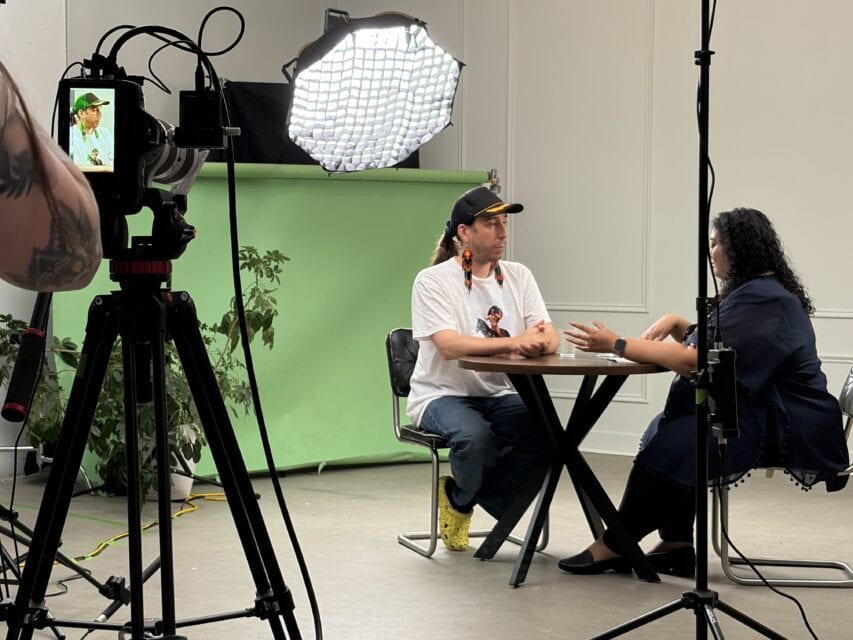
Brive was hired to meet the participants in advance, and then advise the production team on how to word questions. “Instead of asking, ‘What was your most difficult moment,’ it’s ‘What were the obstacles you met along the way, related to your identity,’” she explains. “We prioritize choices, rather than demands.”
Although he didn’t consult Brive, Watso thinks having someone like her on set could be useful.
“You know, a lot of production teams don’t care about the other person at all,” he says. “They just want to get the clip, capture the emotion that’s going to sell, at the expense of the guest, while here it’s the opposite.”
Crucial work, but still not common
Few psychologists offer these services. Brive has participated in a dozen Quebec productions since 2021, including the series Les météorites, where she supported an actor playing a victim of domestic violence, which brought up the actor’s own experiences. “She needed a lot of emotional support between two scenes,” Brive remembers. “She cried, I comforted her, we breathed, we emptied everything out, and we reset. That allowed her to reshoot the scene without having to stop production.”
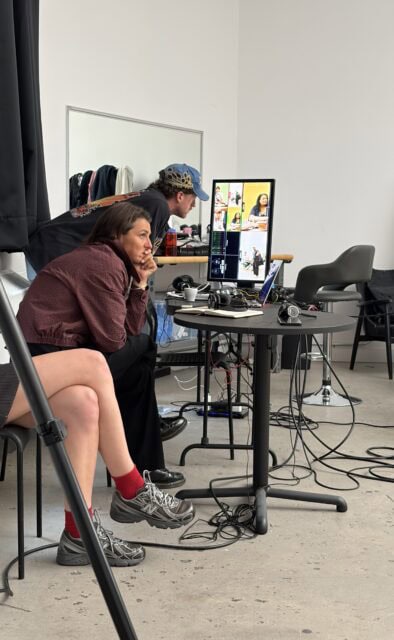
The goal of this work is never to hinder the project, she says. “I work with the director, and I want their film to be what they want it to be,” says Brive, who adds it’s important to create conditions where everyone can feel good.
Alice Ride, founder of Set Protect, a Canadian organization that offers support for psychological health and safety in the entertainment industry, says implementing mental health resources on film sets has been slow to gain traction.
Set Protect offers eight therapists and certified mental health counsellors, as well as 15 professionals who are on call for interventions, if necessary. But the demand could be greater. Ride points to the lack of information about available resources, and the constraints of tight budgets. She insists, however, that support can be tailored to different needs and financial situations.
Psychologists can also be called in to defuse tense situations or even resolve conflicts within production teams. A new role has emerged on set — the mental health coordinator, similar to an intimacy coordinator.
“So it could look like somebody’s on set and they’re available to talk to anyone at any time,” says Ride. “The main difference is that mental health coordinators become part of the crew, whereas a counsellor is brought in specifically for one pass, one event or one shoot day that’s traumatizing.”
Documentary and reality TV sets are better equipped
Ride says the Canadian documentary sector is more motivated to use psychological services than other parts of the industry because of the impacts its sensitive content can have on participants. She points to the Documentary Organization of Canada (DOC). After publishing the DocuMentality report in 2023, about issues affecting mental health in the sector, DOC started allocating a budget for mental health care.
The demand is also strong in reality TV. “They almost all have psychologists now,” says Dania Ramirez, a clinical psychologist who specializes in supporting contestants on reality TV productions.
She’s worked on several popular French-language reality TV shows, including Occupation Double, Star Académie and L’île de l’amour (a French version of Love Island). She’s also working on a reality TV show out this fall, Complètement dans le champ, where content creators work on a farm for two weeks.
When advising on cast selections, Ramirez doesn’t look for interesting personalities. Instead, in a meeting that lasts a little under an hour, she evaluates whether the person is prepared to have a seriously stressful experience. “We identify the person’s possible fragilities, how they function, and their capacity to adapt,” she says. “It’s already happened where I’ve said, ‘This person is really too fragile.’ The production always makes the final decision, but I’ve never raised red flags that weren’t taken into consideration.”
Ramirez remains available throughout the production for telehealth sessions. For example, she may be called in to de-escalate a group conflict, as happened in 2022 for Occupation Double Martinique. She was rushed to the set when a bullying scandal rocked the production to the extent that backers pulled out and several contestants were let go.
“Ideally, if we’re supporting the participants, we shouldn’t support the production team as well, to avoid conflicts of interest. These are different roles that should be held by different psychologists,” says Ramirez.
The return to real life can also be tough for reality TV contestants, so sessions are scheduled with the psychologist. They’re brief, but the goal isn’t to resolve everything; instead Ramirez explains they’re trying to “de-dramatize things, re-contextualize what it meant to participate in the show.” If the needs are larger, the person can be referred to other resources.
Best practices for set psychologists
Everyone interviewed agrees that set psychologists’ roles and boundaries need to be clearly defined from the beginning, to respect the profession’s ethical framework.
It would be helpful to establish a specific framework for film sets within professional organizations; something Ramirez is trying to do with the Ordre des psychologues du Québec (Quebec Order of Psychologists).
Ride notes that WorkSafeBC, British Columbia’s provincial organization responsible for health and safety at work, has proposed a new rule to integrate the management of psychosocial risks for all employers in the province, including those in the film and television production sector. A public consultation is currently underway on this subject.
For the rest, Ride wants more research on the importance of psychological support in the workplace to be done in North America, to raise awareness of needs, and to then formulate policy, both in production environments and with governments.