Télé-Québec brand MAMMOUTH evolves to keep young people watching
To stay relevant to teens, Télé-Québec is evolving its MAMMOUTH brand — previously known for broadcasting specials to young audiences — for a new era. With MAMMOUTH: le studio, Quebec’s public broadcaster is abandoning televised galas in favour of social media content. We look at how and why they made the shift.
On YouTube and TikTok, MAMMOUTH: le studio’s shorts are gradually becoming a regular part of Quebec teens’ digital habits. In one, young Noura takes a trip to a clothing store and comments on outfits as she tries them on between aisles. In another, Ryad shares five tips for taking part in sports while on a five-kilometre run.
Previously, the MAMMOUTH brand was best known for the year-end gala La Soirée MAMMOUTH, an annual show for young people that ran on Télé-Québec, Quebec’s public educational broadcaster, from 2017 to 2024 and celebrated the events and issues of that year with sketches, parodies and musical performances.
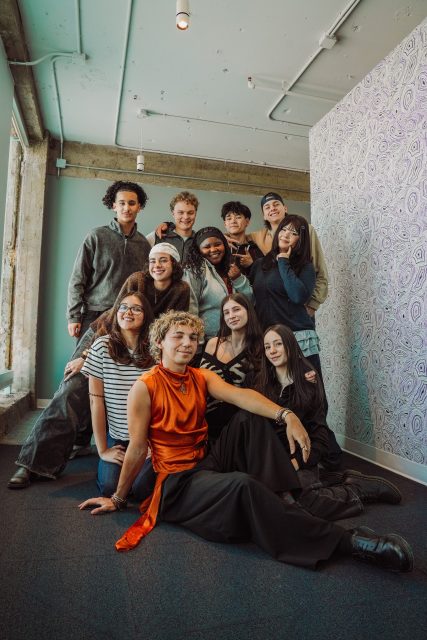
Since March, the new Télé-Québec project MAMMOUTH: le studio has instead provided an incubator for 10 young people, including Noura and Ryad, to take their first digital steps while learning from industry professionals. Together, they form the first cohort of MAMMOUTH: le studio.
Selected through a competition launched in collaboration with Quebec-based media group URBANIA, these budding content creators share their perspectives on YouTube and TikTok, platforms they’re already using daily. Over the course of a year, they will explore diverse themes — from humour to history to cooking — using language and references specific to their generation.
The goal is to reach 13- to 17-year-olds with content that emphasizes interaction and an exchange of ideas.
“The MAMMOUTH brand has existed since 2017,” explains Marysol Charbonneau, director of youth and family programming for Télé-Québec. “It’s known different iterations over the years, including La Soirée MAMMOUTH and the Bal MAMMOUTH [a virtual prom broadcast for high school grads during COVID]. Although we’ve had success with these televised gatherings, they were mostly reaching families and young adults. To reach teens, we had to reinvent the brand without abandoning MAMMOUTH’s core values, which are about developing civic awareness.”
Teens are abandoning traditional media
MAMMOUTH’s repositioning is part of a larger transformation in the industry — teenagers are mostly abandoning traditional media in favour of digital platforms. According to a 2024 study from the University of Laval, 80 percent of Quebecers aged 13 to 17 watch videos online, and 81 percent have at least one social media account.
“Young people love social media because it gives them a feeling of control and independence; they can choose when, where, with whom and how they consume content,” says Nina Duque, a lecturer in the Department of Social and Public Communication at the University of Quebec in Montreal, and a researcher of adolescents’ digital practices.
“That’s where they test out their choices and construct their identity at a stage in their lives where they want to detach themselves from the family unit,” she says.
Another reason young people rarely watch linear television is that they no longer recognize themselves in it, says Duque. “Why would young people want to suddenly swap their cellphone for a TV that doesn’t move,” she asks. “The content is now integrated [into their digital universe], and that’s never going away.”
What teens want to hear
What are young people looking for on social media that they don’t find elsewhere? Spontaneous content that doesn’t seem staged or overly dramatic, says Duque.
“Teenagers don’t want to feel there’s an adult behind the words, and even less an adult trying to grab their attention with a line like, ‘Hey, you, kid!’” she says. “Instead, they want to hear something more confessional like, ‘Have you heard what happened to me today? It was completely crazy…’”
In response to these generational differences, MAMMOUTH: le studio focuses on accessible, spontaneous videos that relate to teenagers’ daily lives. “These are young people talking to other young people, so we don’t want to sterilize their messages or correct their mistakes in French,” says Charbonneau. “Anglicisms are part of their identity because the French language evolves according to immigration and the influences of globalization.”
The recruits also have a lot of freedom in the editorial process and their subject matter, though they are advised by a producer, called “nounou” (“nanny”), and a content manager from Télé-Québec.
“We don’t want to decide for them what interests them, concerns them, and makes them laugh,” says David Ostigny, director of editorial and social content at Télé-Québec. “If we impose our vision of what young people should like we risk making a mistake.”
And, contrary to popular belief, teenagers do like to learn and understand. Duque insists they are perfectly capable of watching long videos on YouTube, especially in the evenings, in their rooms, when they find a video that fits their needs. During the day, they tend toward a more fragmented, rapid consumption of content on social media, especially TikTok, a platform where 40 percent of Quebecers between the ages of six and 17 have an account, according to a joint investigation conducted by federal and provincial commissions for the protection of private life that was launched in 2023.
A new network logic
Traditionally, public broadcasters provided content on a fixed schedule hoping to attract viewers to their channels. Today, they have to be where their audiences are, on diverse platforms, at the right moment, and with relevant content.
In this diffuse model where everyone consumes and shares information, Duque says a broadcaster’s goal isn’t to reach all teenagers, it’s more about reaching influential teenagers who are capable of circulating content widely amongst their community.
Ostigny says that, since its launch, MAMMOUTH: le studio has reached its target audience.
The proof is in the comments from young consumers and the number of views, which surpass 100,000 for some TikTok videos. The next steps are aimed at increasing the project’s visibility and developing a loyal audience by using recurring personalities.
“There will be a second cohort of content creators next year, with the possible return of some previous ones. But it’s not our only conversation with 13- to 17-year-olds; other new initiatives will follow,” says Ostigny, without being able to elaborate at this time.
