The golden age of puzzle games
The most popular video games in Canada aren’t shooters like Fortnite, open-world games like Grand Theft Auto, or sports simulations like NHL 26. They’re puzzle games like Wordle, Jeopardy! and Tetris. The trend comes as no surprise to developers.
A study published by the Entertainment Software Association of Canada (ESAC) in October 2025 shows that the most popular video games with Canadian players aged 16 and up are puzzle games like Tetris, Sudoku and Wordle.
According to the report, Power of Play, 59 percent of respondents reported that puzzle games was the genre they’d “played most regularly in the last year,” compared to 39 percent who said the same for action games and 30 percent for games of skill and chance. (Respondents were presented with a list of game categories and asked to select all genres they play regularly, which is why the total adds up to more than 100 percent.)
Puzzle games comprise a large range of sub-genres, including matching games (Candy Crush, Tetris), brainteasers and word games (Sudoku, Wordle), physics-based games (Angry Birds), educational games (ABCmouse), and trivia games (Jeopardy!).
A Needed Break
The trend doesn’t surprise Lukas Steinman, co-creator of the puzzle game A Little to the Left and co-founder of the Nova Scotia game studio Max Inferno Games. Steinman says this type of game serves as a counterpoint to players’ frenetic media landscapes and busy schedules.
“Puzzles allow us to slow down, focus on a single task at hand, and feel that pang of pride and success when a solution is found,” he says.
Mark Rogers, co-creator of the online word game Canuckle, which offers a free, daily, typically Canadian word for players to guess (similar to The New York Times’ Wordle), agrees. “Players crave something they can finish quickly — a single, intentional task instead of an endless scroll,” he says.
More than 230 million games of Canuckle have been played since it launched in February 2022, with approximately 50,000 players — mostly Canadian — playing it every day. For Rogers, daily word games like Canuckle have largely become “part of modern, digital self-care.”

Mobile Devices Behind Puzzle Games’ Popularity
Puzzle games also owe their popularity to mobile devices, according to Jason Kapalka, founder of the B.C.-based studio Blue Wizard Digital.
“Mobile devices are more suited to puzzle games than they are to, for example, first-person shooter games,” he says. Kapalka also co-founded the PopCap Games studio back in 2000 and has experienced this transition firsthand over the years as PopCap released games like Bejeweled and Plants vs. Zombies across various platforms.
The market also follows demographic changes, and gamers are getting older.
“Now we see players who are entering retirement, who are looking for games to play. People who enter retirement at this stage don't want Twitch-based games, shooting games, competitive games. They want stimulating games, social games, games they can play with their family,” says Carina Kom, co-founder of the independent studio Simply Sweet Games, whose first release, the word-puzzle game Criss Cross Castle, launched recently.
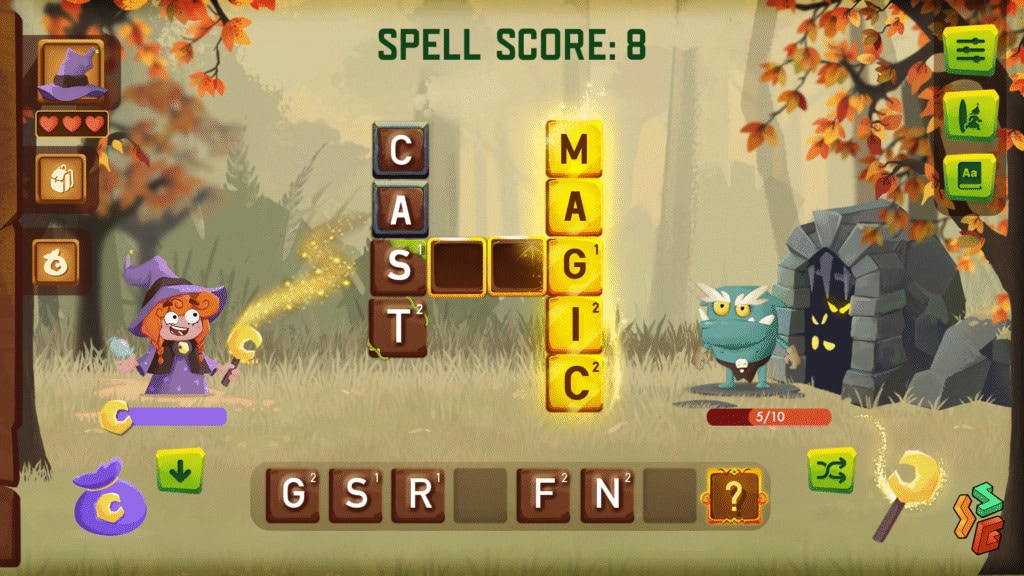
The genre’s popularity with women is also significant. “More than half of all gamers are women, and 75 percent of the players playing puzzle games are women,” says Tina Merry, CEO of Simply Sweet Games.
The Appeal for Small Studios
Puzzle games often represent an attractive option for independent studios. “They're relatively easy to make…and often don't have the same sort of art/audio requirements. They also have very low technical requirements most of the time, which means that they are able to be played by even low-spec devices, and would reach a wider audience than traditional video games can,” said Steinman.
Steinman’s game, A Little to the Left, has sold 2.5 million copies, and its downloadable content has been purchased 1.5 million times. According to Steinman, the game has made “a good return on investment.”
“Puzzle games punch way above their weight,” says Rogers. “A small creative idea, executed well, can connect people around the world.”
What’s more, puzzle games have room for innovation. New games are emerging like Slayaway Camp 2, which blends puzzles with horror, and markets itself on Steam as the “most violentest” puzzle game of all time.
Even if they are easier to design, developing a game is still a challenge.
“We went into this genre because we thought it would be easy, and we were wrong,” says Merry. “We were so wrong. Anytime you make a new game or any new IP with a new team and new technology, that is going to be hard.”
That doesn’t mean puzzle games aren’t a good opportunity; the market is evaluated at $30 billion (U.S.) worldwide, according to data compiled by Simply Sweet Games.
“All you need is to find a small portion of the market that is looking for what you have to offer,” says Merry.
