Bringing trans realities to the screen
This Pride Month, Now & Next explores the best ways to approach the realities of trans life today, behind the scenes and on screen. We asked two trans artists, Gabrielle Boulianne-Tremblay, who co-wrote the film François.e, and director Luis De Filippis, for their thoughts.
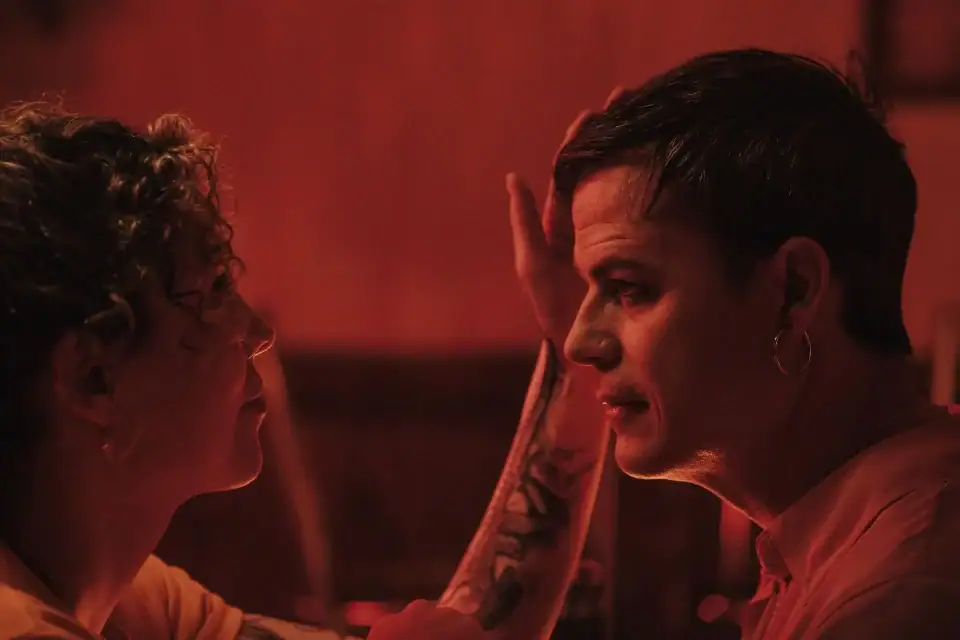
Ten years ago, the Toronto International Film Festival awarded the prize for Best Canadian Film to Ceux qui font les révolutions à moitié n'ont fait que se creuser un tombeau [Those Who Make Revolution Halfway Only Dig Their Own Graves]. A few months later, the Quebecois feature received a special mention from the jury at the Berlin International Film Festival. At the time, one of the characters — a young trans revolutionary played by Gabrielle Boulianne-Tremblay — received particular attention.
“I think about it every year,” recalls actor/writer Boulianne-Tremblay, who was dropped into a media frenzy from her very first acting experience. “I didn’t have any training, I sort of threw myself into the unknown, like jumping into the void. I didn’t know if the parachute was going to open, but I really hoped it would.”
The interest surrounding the film, including a noteworthy appearance on the Quebec talk show Tout le monde en parle, helped awaken audiences’ awareness and empathy toward the trans community, while giving the film industry an updated perspective and promoting wider reflection.
“When I was growing up there wasn’t a good perception of trans people on screen,” recalls Boulianne-Tremblay. “We laughed at them a lot, they were often treated as ridiculous. They were either made to be spectacles, or they suffered and died.”
The Story of François.e
The team behind the new movie François.e, produced by KO24 with financial support from the Canada Media Fund, absolutely wanted to avoid these mistakes. That’s why, after having read Boulianne-Tremblay’s book, Dandelion Daughter, producer Louis Morissette and screenwriter Jean-François Léger asked her to co-write the screenplay for François.e, which opens July 1.
“I often say it was written with four hands,” says Boulianne-Tremblay, “and also with two hearts. I don’t think I’ve ever seen a team of screenwriters made up of a cisgender man [Léger] and a trans woman in Quebecois cinema. Already, that is growth and very evocative of where we’ve gotten to in our society.”
François.e tells the story of François (played by Morissette), a writer in the midst of a midlife crisis who falsely pretends to be a trans woman to obtain financing for his new series. As one might imagine, his plan quickly falls apart.
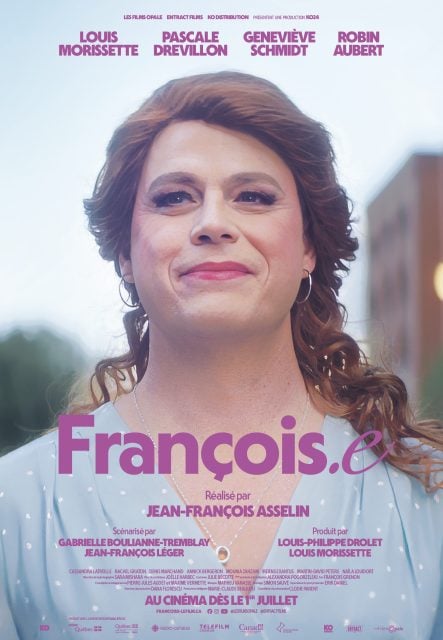
Several weeks before the film’s release, its poster, which depicts Morissette as a woman, and trailer have provoked a reaction from the trans community, especially in France. Some people are upset to see a cisgender actor in the title role of a trans woman.
Boulianne-Tremblay says it’s important to grasp the intention behind the film’s story.
“Our mission with this film is to take the viewer, with all their preconceived ideas, and bring them elsewhere,” she says. “This is a film that speaks about the cisgender perspective on trans life; how the character of François is going to be confronted by his own preconceptions, by a reality he is completely unfamiliar with, and question himself, but never using mockery.”
Taking Up Space
The heated reaction speaks to the growing consensus that, despite Christian Bégin’s brilliant performance in M'entends-tu? [Can You Hear Me?] or John Lithgow’s in The World According to Garp, the trans community believes trans characters should henceforth be played by trans people.
Boulianne-Tremblay agrees wholeheartedly, as does Ontario filmmaker Luis De Filippis, whose films place trans protagonists centre stage.
“As much as I believe in non-trans filmmakers making trans stories, because no one owns any story, I don’t believe non-trans actors should be taking trans roles,” says De Filippis, who’s been winning awards since her first films at the prestigious Sundance, Toronto, Rotterdam and San Sebastián festivals. “You might not find a classically trained trans actor, you might have to do more of a grassroots approach, but that doesn’t mean the person that’s right for that role is not out there. You just have to put a little more work in the casting process.”
The heroine of De Filippis’ first feature film, Something You Said Last Night, was played by Carmen Madonia, who wasn’t a professional actor. De Filippis says that didn’t prevent Madonia from delivering an incredibly moving performance. To put her star at ease on set, De Filippis used an approach that could catch on — mentorship.
“I didn’t want us to be the only trans people on set,” says De Filippis. “So, Carmen knew in the morning that when she had to get dressed, there was a trans woman dressing her and there was a trans girl doing her makeup. She knew there was a trans girl behind the camera. She gives a very honest performance in the film and it’s because she knows she is supported and she is surrounded by people who understand her and know both what her character is going through and what she is going through.”
Principles to Follow
De Filippis’ approach delights Boulianne-Tremblay, who plans to use it for future projects.
Already excited that François.e brought 11 trans actors together on screen — one of the most beautiful moments of her life — she offers several additional ideas to foster positive representation of her community on screen and assure their well-being on set.

First, make the whole team aware of a trans person’s presence and the realities of their lived experience before they arrive. Then, following De Filippis’ example, include trans people in different production roles. When it comes to storytelling, focus on positive, diverse narrative models so audiences don’t associate trans identity solely with situations of suffering or stories about transition. Also, whenever possible, donate a portion of revenue to organizations that support the community. Finally, as was the case with François.e, vary the dramatic genres by alternating between funny moments and deeper scenes.
Boulianne-Tremblay is well aware that the more a film reaches people outside the community, the more it has the opportunity to increase people’s empathy and broaden horizons.
“All my life, even before I was famous, I’ve tried to bring people together,” she says. “My proudest moment with this project was that we see a new side of our communities, positive representation of trans men and women in situations of power and autonomy. We’re opening people’s hearts up to another reality than what the majority of the population is familiar with, even today. At a time when bridges are burning, if a film like François.e can extend a hand towards the other, towards both sides, if it can inspire people and be a useful work, all the better.”