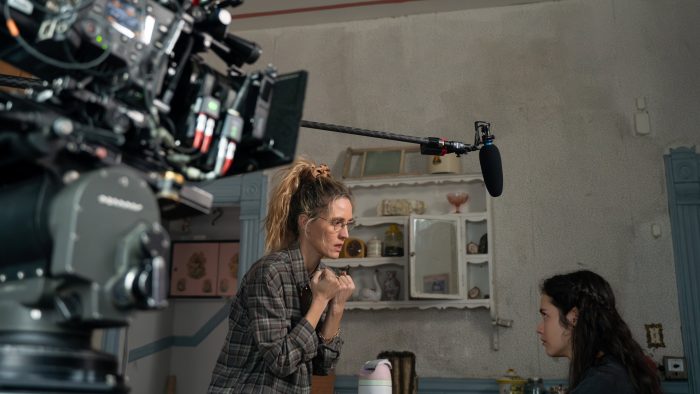
Against a challenging backdrop, the world still wants our kids’ content
Canadian children’s programs reach audiences across the globe, but as commissions shrink and viewing shifts to other platforms, producers are being forced to rework their strategies.
A recent report prepared by Ampere Analysis for Telefilm Canada shows that Canada is one of the world’s five leading producers of children’s programming, alongside the United States, France, the United Kingdom and Japan. (The study excluded China and Russia.)
According to the Telefilm Canada Kids’ Content Report, in 2025 there were 22 international markets with access to at least 1,000 hours of Canadian kids’ content. Some countries had a lot more. Between live-action and animated content, there were well over 5,000 hours of Canadian kids’ content available in the United States, more than 3,000 hours in Australia and nearly 2,500 hours in both the U.K. and Mexico.
Canada’s biggest success story in the field may be Spin Master’s PAW Patrol, available in more than 160 countries. The $15 billion (U.S.) mega-franchise includes 14 seasons of the original series, spinoff series Rubble & Crew, and numerous films, including this summer’s hit feature PAW Patrol: The Dino Movie, which earned more than $100 million (U.S.) worldwide in its first month.
But it’s not all good news, says the report.
Canadian children’s commissions (where broadcasters pay production companies to create shows) fell 33 percent in the 12 months leading up to the third quarter of 2025, marking the country’s sharpest annual decline since 2020. And, globally, investment in children’s and family content by major linear broadcasters (i.e., network television) has continued to decline, falling from approximately $5.4 billion (U.S.) in 2020 to $3.7 billion (U.S.) in 2025.
Maria Kennedy, co-founder and executive producer of Little Engine Moving Pictures, the company behind the animated series Tiny and Tall, says that drop in investment is forcing the industry to change.
“The future will require a fundamental shift from being a company that makes shows for broadcasters and streamers to a company that builds audiences, brands and intellectual property,” she says.
Designing content with the whole world in mind
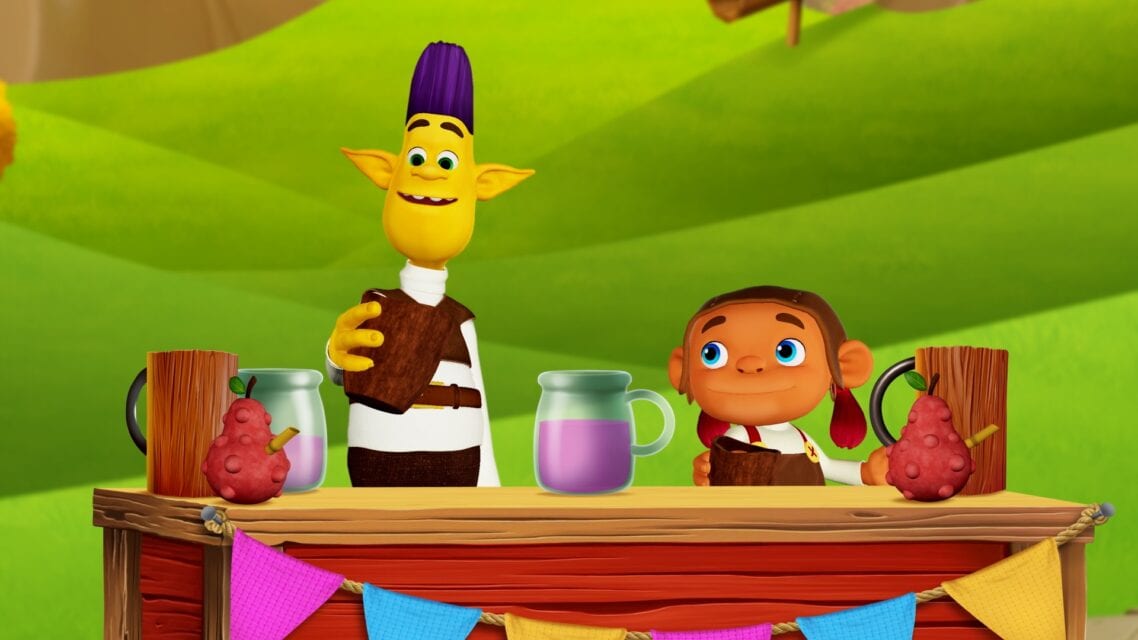
“Our domestic market is small relative to the cost of a well-made animated series, so Canadian studios have long designed content with international co-production and multiple broadcaster relationships in mind,” says Shabnam Rezaei, co-founder and president of Big Bad Boo Studios, creators of the award-winning animated series The Bravest Night.
The company began nearly 20 years ago with a short film about Persian New Year and has since expanded to operate studios in Vancouver, New York and Vienna. Its programs have reached more than 100 countries and cover 40 languages. Its streaming platform, Oznoz, distributes children’s programming in several languages as well.
Rezaei founded the company partly to challenge representations of Iranian and Middle Eastern identity after 9/11. “While we used to get labelled ‘niche,’ the thinking now, and hopefully forever, is that specific is universal,” she says.
What began with culturally specific stories soon became the foundation for an international business.
“By the time a show is in financing or production, most of the decisions that determine whether it travels have already been locked in,” Rezaei says.
Her team tests whether the characters, humour and emotional beats will work in foreign territories and if a project should be structured as an official Canadian-content production or an international treaty co-production.
Animation travels well
The Ampere report found that while Canadian live-action programming travels most easily to English-speaking markets, particularly the United States, Australia and the United Kingdom, animation reaches more territories where neither English nor French is the dominant language.
That’s partly because characters can be dubbed without replacing the original performances, but Rezaei cautions that effective localization requires more than translating dialogue.
“Good localization is cultural adaptation,” she says. “Names, references and dialogue need sensitivity to the market. A good joke can work in one setting and not in another.”
French-language Canadian content remains concentrated primarily in France and Belgium, according to the study. There are exceptions, such as French-language animated titles available on Arabic streaming platforms, but the overall volume remains considerably smaller than English-language exports.
Steve Couture, CEO of Quebec City-based Epic Storyworlds, believes language should be treated as a jumping-off point rather than a limitation.
His company’s animated series Guiby the Super Baby is adapted from the graphic novels created by French-Canadian author/illustrator Samuel Parent. The stories follow a very young child as he confronts his fears and faces mythical monsters from an underground world.
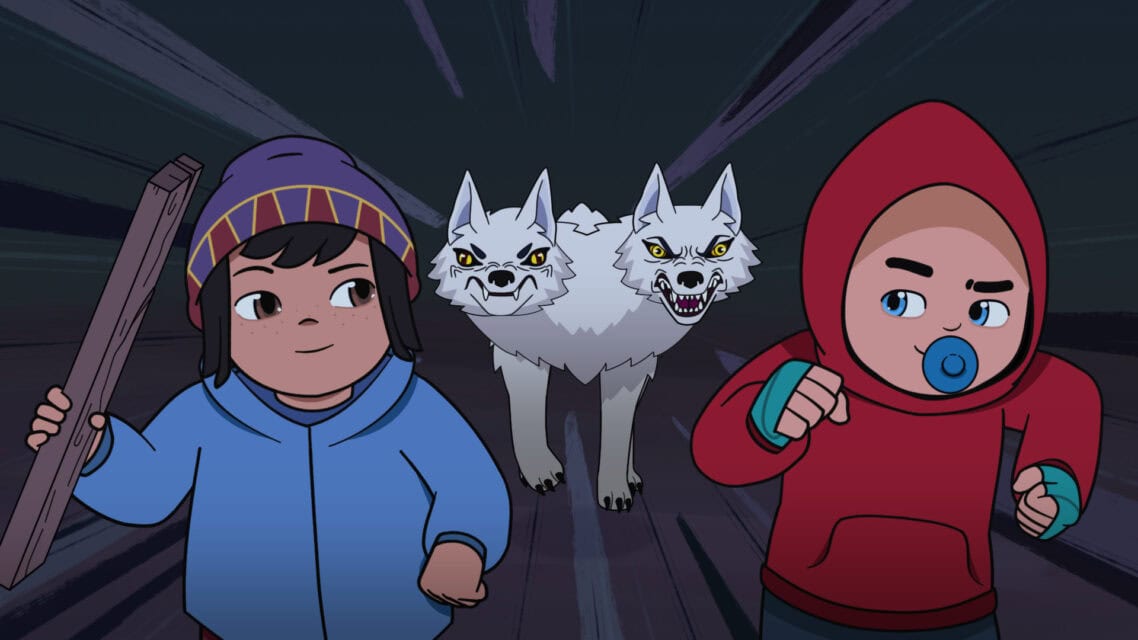
“The original graphic novels resonated with kids who love spooky and exciting stories,” Couture says. “At the heart of the story, we see a very young child facing his fears. These stories are universal.”
The series premiered on Télé-Québec’s linear channel and streaming service before expanding to YouTube. Its first major global agreement, with TV5Monde+, provides access to viewers throughout the international Francophone market.
“There are many Francophone audiences around the world and, while this is a starting point, we are seeing great interest in other territories,” Couture says. “The great thing about animation is that it feels local to audiences around the world as we dub the series into local languages.”
The lure of well-known IP
The proportion of children’s commissions based on books, franchises and other established intellectual property (IP) has risen substantially, according to the Ampere report. Among Canadian public-media commissioners, the share doubled between 2021 and 2025.
Read more: Why literary works are so popular on screen
Kennedy says the threshold for buyers has changed. “Buyers need confidence that the project is discoverable, brandable and capable of building a long-term relationship with audiences,” she says.
She now looks beyond broadcasters and streamers to partners that already have young audiences, including creators and sports organizations.
“Can kids in the U.S., U.K., France, Indonesia or Venezuela enjoy the IP in the same way as Canadian kids?” she asks. “Can I partner with trusted content creators who have already built audiences who are dedicated fans?”
Going platform agnostic
International success can no longer rely on a single worldwide sale.
The Ampere report found that major advertising-supported services such as Tubi and Roku carry significant volumes of Canadian children’s programming. Local broadcasters and streaming platforms remain important too. Negotiating territory-by-territory deals takes more work, but those agreements can add up and allow local companies to market programs in ways that suit their audiences.
The best strategy often layers broad, non-exclusive agreements with major streaming platforms and more targeted sales to national broadcasters and local services, according to the report.
“A signed broadcaster or streamer becomes proof of concept for the next conversation,” Rezaei says. “It is not automatic. Each territory has its own programming needs, scheduling gaps and cultural-fit questions.”
Markets such as MIPCOM and Cartoon Forum are useful for meeting potential buyers and co-production partners. But Rezaei believes producers must think of them as the start of relationships that can take years to produce a signed agreement.
For Kennedy, the question is, “How does a kids’ show break through the noise?”
“Canadian kids’ content still has strong global appeal, and opportunities to build global kids’ audiences are bigger than ever, but the business model has completely changed,” she says. “Audience attention has fragmented. Discoverability is now as important as production quality.”